1099 vs. W-2: The Mistake That Can Cost You an IRS Audit
Misclassifying a worker as a 1099 contractor when they should be a W-2 employee is one of the most common — and most expensive — mistakes in construction. Here's how to get it right.

The High Cost of Misclassification
In construction, worker misclassification is a major issue. Many contractors classify workers as 1099 independent contractors to avoid payroll taxes, workers' compensation, and unemployment insurance. But the IRS and state agencies are paying close attention — and the penalties for misclassification can be severe.
If the IRS determines that a worker was misclassified, you may be liable for:
- Back payroll taxes: Federal and state income tax, Social Security, Medicare — plus interest and penalties.
- Workers' compensation penalties: If a worker is injured and was misclassified, you may be liable for the injury claim.
- Unemployment insurance: You may owe back UI contributions.
- Liability: The worker may sue for benefits they should have received.
The IRS Test: Employee or Independent Contractor?
The IRS uses a multi-factor test to determine whether a worker is an employee (W-2) or an independent contractor (1099). The key question: does the employer control how the work is done?
The test considers three categories:
- Behavioral control: Does the employer control how the work is performed? (Tools, hours, methods.)
- Financial control: Does the employer control the financial aspects of the work? (Pay rate, expenses, profit/loss.)
- Relationship: Is there a contract? How permanent is the relationship?
Common Misclassification Mistakes in Construction
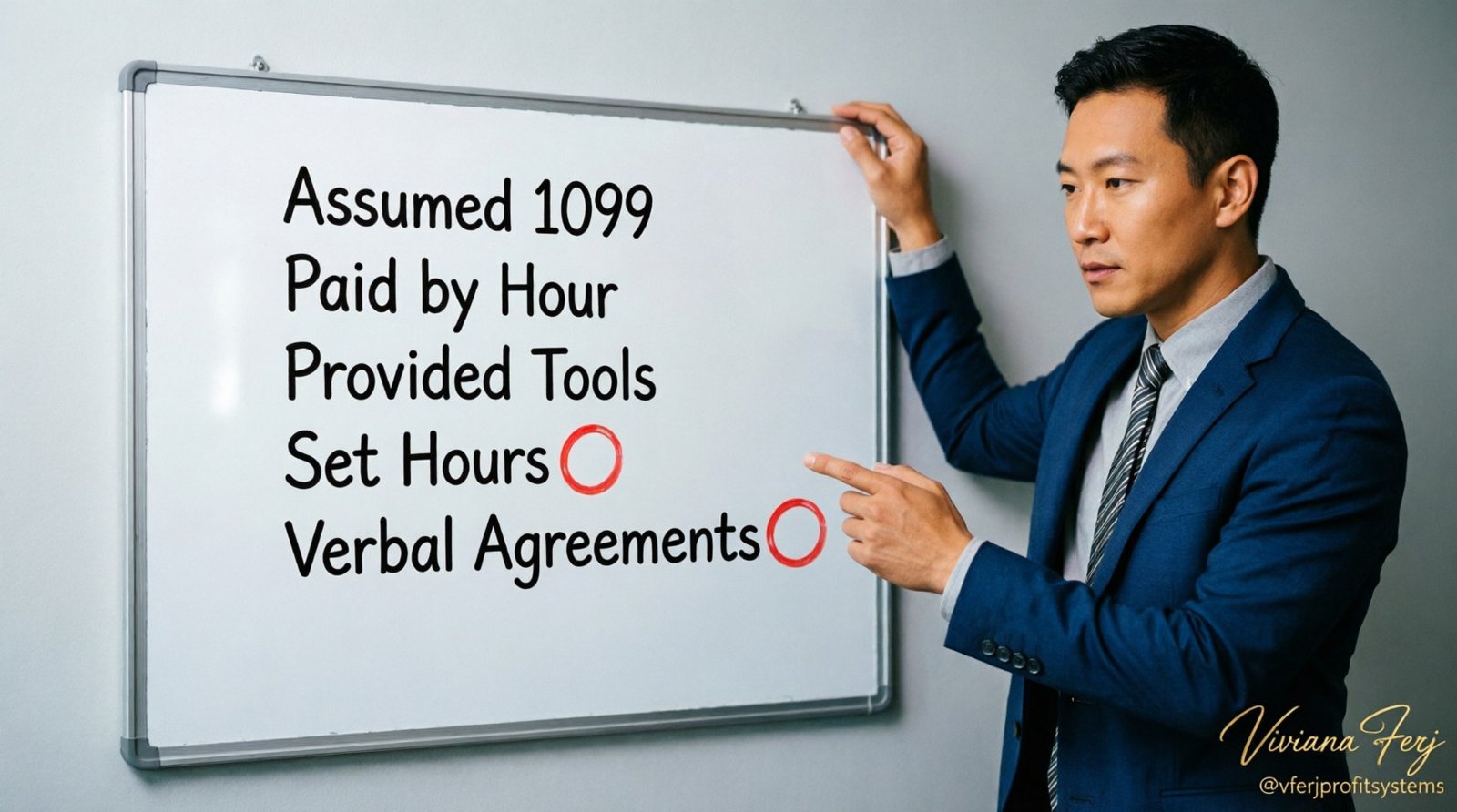
- Assuming all workers are 1099: Many contractors assume that if a worker has their own tools, they're a 1099. That's not enough.
- Paying by the hour: If you pay a worker by the hour, that's a strong indicator of an employee relationship.
- Providing tools and equipment: If you provide tools, that suggests control — and an employee relationship.
- Setting work hours: If you set the worker's schedule, that's a behavioral control factor.
- Using verbal agreements: A written contract doesn't guarantee 1099 status. The IRS looks at substance, not form.

The Consequences of Getting It Wrong
- IRS audit: Misclassification is a common trigger for an IRS audit.
- Back taxes and penalties: You'll owe back taxes, plus interest and penalties — often going back several years.
- State penalties: States also enforce worker classification rules and can impose their own penalties.
- Bonding impact: Tax liens from misclassification can reduce your bonding capacity.
- Reputational damage: Misclassification can damage your reputation with clients and sureties.

How to Get It Right
- Understand the IRS test: Review the IRS guidelines on worker classification. Don't rely on assumptions.
- Use written contracts: Have a written agreement that clearly defines the working relationship.
- Document your analysis: Document your reasons for classifying a worker as 1099. If the IRS questions it, you'll need evidence.
- Review your workforce: Regularly review your workforce to ensure classifications are still correct.
- Work with a payroll specialist: Payroll is complex. A specialist can help you avoid mistakes.
The Safe Harbor: Section 530
If the IRS questions your classification, you may be protected under Section 530 — a safe harbor that protects employers who have a reasonable basis for their classification. However, you must meet specific requirements:
- You must have treated the worker as a 1099 on all filings.
- You must have a reasonable basis for the classification (e.g., industry practice, judicial precedent, or IRS audit of a similar situation).
- You must have consistently treated the worker as a 1099.
Section 530 is not a guarantee — but it's a useful protection if you can demonstrate a reasonable basis.

Frequently Asked Questions
Can a worker be both a 1099 and W-2?
Yes — a worker can have different roles for the same employer, as long as the roles are genuinely different. But this is a red flag for the IRS.
What if the worker prefers to be 1099?
The worker's preference doesn't matter. The IRS looks at the facts of the relationship, not the worker's preference.
What's the penalty for misclassification?
Penalties can include back taxes, interest, and fines — often 20% or more of the unpaid tax. State penalties can add to the total.
Can I classify a worker as 1099 if they work for other contractors?
Yes — if they work for multiple contractors and have their own business, that's a factor that supports 1099 status. But it's not a guarantee.
Take This to a Full Diagnostic of Your Operation
- Real profitability per job, not just company-wide
- Worker classification and payroll compliance
- Tax provision and multi-state exposure
- Bonding capacity and subcontractor risk

Get These Insights Straight to Your Inbox
A new article on construction finance every month — no spam, unsubscribe anytime.