Direct vs. Indirect Costs: The Mistake That Inflates Your Budget
Misclassifying a cost as direct when it's indirect — or vice versa — inflates your budget, distorts your WIP Schedule, and can cost you bonding capacity and tax accuracy. Here's how to get it right.

The Classification Error That Costs You More Than You Think
Every construction company tracks costs. But not every company tracks them correctly. The distinction between direct costs and indirect costs sounds simple — until you're in the middle of a job, with a dozen subcontractors, multiple suppliers, and a project manager who needs to know whether that fuel charge belongs to Job A or Job B.
Getting it wrong doesn't just mess up your accounting. It inflates your project budgets, distorts your WIP Schedule, and can reduce your bonding capacity. And when tax season comes, misclassified costs can trigger an audit or leave money on the table that should have been deducted.
Direct Costs: The Ones That Belong to a Specific Job
Direct costs are expenses that can be traced directly to a specific project. They include:
- Materials: Concrete, steel, lumber, wiring — anything that goes into the physical structure.
- Labor: Wages for workers who spend their time exclusively on that job.
- Equipment rentals: Cranes, excavators, or tools used solely for that project.
- Subcontractor costs: Payments to electricians, plumbers, or other trades working on that job.
The key test: If the cost disappears when the job disappears, it's direct. If you can trace it to a specific project with certainty, it belongs there.

Indirect Costs: The Shared Expenses
Indirect costs (also called overhead or burden) are expenses that benefit more than one job and can't be traced to a single project. Common examples:
- Job site trailers and utilities: The trailer that serves multiple projects.
- Superintendent salaries: When a superintendent oversees more than one site.
- Small tools and consumables: Drill bits, safety gear, office supplies used across jobs.
- Fuel for vehicles that move between sites: When the same truck serves multiple projects.
These costs need to be allocated across projects using a consistent method — often based on direct labor hours, direct costs, or equipment usage.
The Most Common Mistake: Treating Indirect as Direct
This is where contractors get into trouble. A well-intentioned project manager sees a cost on a job and assigns it directly to that job — even when the cost actually serves multiple projects.
Example: A superintendent earns $8,000 per month and spends 60% of their time on Job A, 30% on Job B, and 10% on bidding new work. If the contractor assigns the full $8,000 to Job A, that job's costs are inflated, its margin looks smaller than it is, and Job B's margin is artificially higher. The result? The company thinks Job B is profitable when it isn't, and thinks Job A is losing money when it's actually fine.

How It Affects Your WIP Schedule
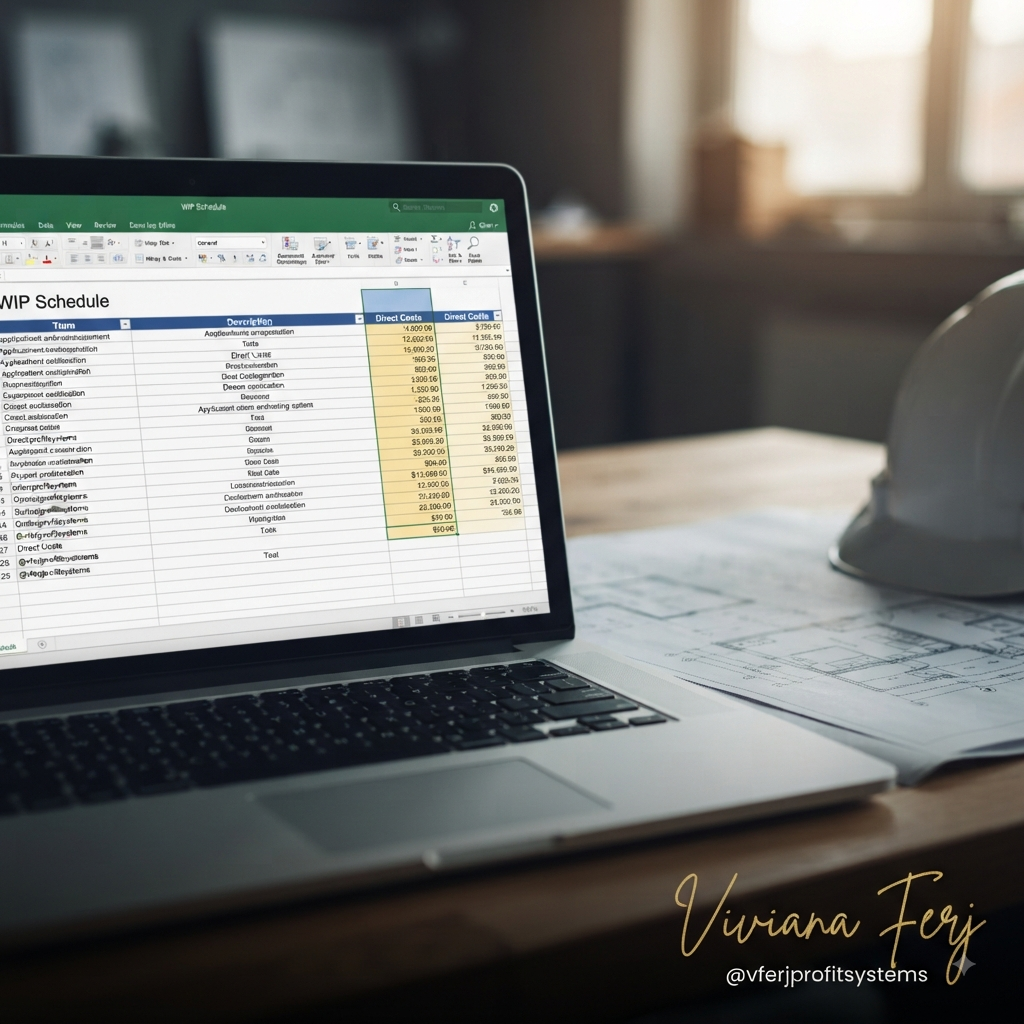
Your WIP Schedule depends on accurate direct costs. If indirect costs are mixed in, the "percent complete" calculation gets distorted — because percent complete is driven by direct costs incurred compared to estimated total direct costs.
A job with a bunch of indirect costs dumped into it will look further along than it is. That leads to over-billing that isn't justified, which shows up as a liability on your balance sheet. It also means your estimated margin is wrong — and you're making decisions based on numbers that don't reflect reality.

The Tax Implications of Getting It Wrong
Under the percentage-of-completion method, taxable income is calculated based on costs incurred and revenue earned. If direct costs are inflated with indirect costs, your percent complete is higher than it should be — and you'll pay taxes on revenue you haven't actually earned.
On the flip side, if you leave indirect costs off the WIP entirely and expense them all at once, you might reduce current-year taxable income — but you've also understated your job costs, which means your margins look better than they are. Either way, you're not seeing the real picture.
A Simple Rule to Get It Right
Here's a rule that works for most construction companies: If the cost goes away when the job ends, it's direct. If it stays even when the job ends, it's indirect.
Materials, direct labor, and subcontractors are direct. Job site trailers, shared equipment, and superintendent oversight are indirect. And when in doubt, ask: "Can I point to a specific invoice that ties this cost to this specific job?" If you can't, it's indirect and should be allocated.
Frequently Asked Questions
Can a cost be both direct and indirect?
Not on the same job. But the same expense can be direct for one job and indirect for another — fuel for a truck dedicated to Job A is direct; fuel for a truck that serves five jobs is indirect.
How should I allocate indirect costs?
Most contractors use a simple allocation base: direct labor hours, direct labor dollars, or equipment hours. Pick one and apply it consistently across all jobs.
Does this affect my bonding capacity?
Yes. Sureties look at job profitability and WIP consistency. If indirect costs are misallocated, your job margins aren't reliable — and that reduces a surety's confidence in your numbers.
What's the biggest red flag for an auditor?
Inconsistent classification. If Job A has a superintendent cost assigned to it and Job B doesn't — even though both jobs have a superintendent — that inconsistency will raise questions.
Take This to a Full Diagnostic of Your Operation
- Real profitability per job, not just company-wide
- WIP Schedule and detection of misclassified costs
- Tax provision and multi-state exposure
- Bonding capacity and subcontractor risk

Get These Insights Straight to Your Inbox
A new article on construction finance every month — no spam, unsubscribe anytime.