R&D Tax Credits That Most Contractors Don't Claim
Construction contractors are eligible for the R&D tax credit — but most don't claim it. Here's what qualifies, how to document it, and how to claim it.
The Most Overlooked Tax Credit in Construction
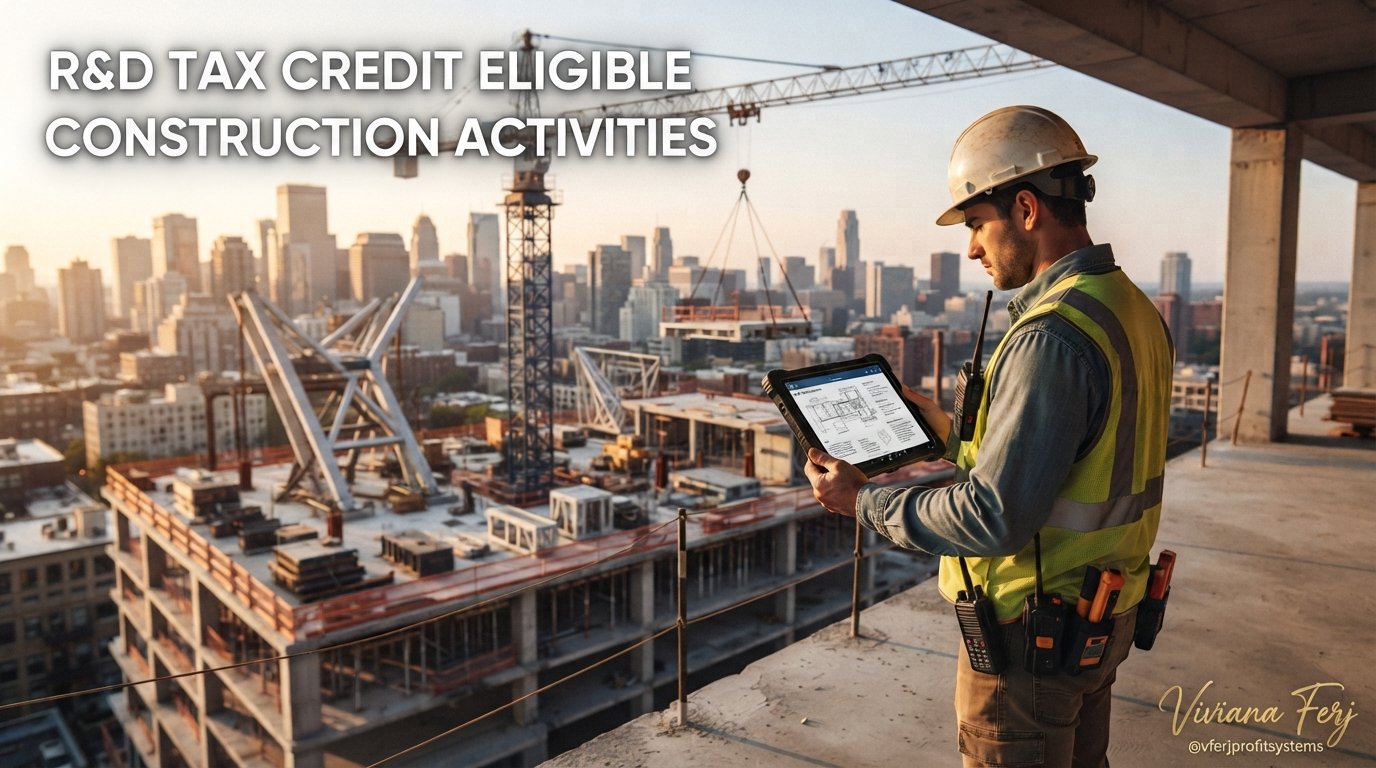
The R&D Tax Credit (Research & Development) is one of the most powerful — and most overlooked — tax credits available to construction contractors. Many contractors assume that R&D is only for tech companies or manufacturers. But construction activities that involve innovation, experimentation, or technical uncertainty can qualify.
If you've ever:
- Developed a new construction method or technique,
- Improved a construction process to reduce costs,
- Experimented with new materials or systems, or
- Solved a technical problem on a project,
you may qualify for the R&D tax credit.
What Qualifies as R&D in Construction
To qualify for the R&D tax credit, your activities must meet the Four-Part Test:
- 1. Permitted purpose: The activity must create a new or improved product, process, or technique.
- 2. Technical uncertainty: At the beginning of the activity, you didn't know if it would work — or how.
- 3. Process of experimentation: You tested alternatives — through trial and error, simulation, or modeling.
- 4. Technological in nature: The activity relies on engineering, science, or a hard science.

Examples of Qualifying Construction Activities
- Developing a new construction method: A new way to pour concrete, erect steel, or install a system.
- Improving energy efficiency: Developing a building envelope or HVAC system that exceeds code requirements.
- Using new materials: Testing the use of recycled or composite materials on a project.
- Developing innovative structural systems: A new bracing system, foundation type, or seismic solution.
- Solving a technical problem: Figuring out how to build on challenging soil, in a tight site, or under unusual constraints.

How to Document Your R&D Activities
The key to claiming the R&D credit is documentation. The IRS requires detailed records of your activities:
- Project records: Notes on what you were trying to accomplish and why.
- Design documents: Drawings, specifications, and calculations.
- Testing records: What you tested, how you tested it, and what you learned.
- Time records: The time spent by personnel on qualified activities.
- Cost records: The costs associated with the R&D activity.
Documentation doesn't need to be perfect — but it needs to exist. The IRS will look at your records if they audit the credit.

How to Claim the R&D Credit
- Identify qualified activities: Review your projects and identify activities that meet the Four-Part Test.
- Calculate qualified research expenses: These include wages, supplies, and some contract research costs.
- Complete the necessary forms: Form 6765 — Credit for Increasing Research Activities.
- Amend prior-year returns: If you missed the credit in prior years, you can file amended returns.
- Work with a specialist: R&D credits are complex. A specialist can help you identify eligible activities and maximize your credit.
How the R&D Credit Affects Your Bonding
Tax credits don't directly affect bonding capacity — but they do affect your bottom line. Every dollar of R&D credit is a dollar you don't pay in taxes — and that improves your financial position. A stronger financial position means stronger bonding capacity.

Frequently Asked Questions
Can I claim R&D credits for work on a regular commercial project?
Yes — if the work involved innovation or technical uncertainty. It doesn't have to be a "research" project.
What is the credit worth?
The R&D credit is up to 20% of qualified research expenses above a base amount. It can be significant for contractors who do innovative work.
How far back can I claim the credit?
You can file amended returns for the last three years — and in some cases, longer.
Do I need to be a large company to qualify?
No. Small and medium-sized contractors can also qualify for the R&D credit.
Take This to a Full Diagnostic of Your Operation
- Real profitability per job, not just company-wide
- R&D credit identification and documentation
- Tax provision and multi-state exposure
- Bonding capacity and subcontractor risk

Get These Insights Straight to Your Inbox
A new article on construction finance every month — no spam, unsubscribe anytime.